
Sign In | Starter Of The Day | Tablesmaster | Fun Maths | Maths Map | Topics | More
This is the Transum Newsletter for the month of November 2026. It begins, as usual, with the puzzle of the month.
Four students in the next room could be heard comparing the percentage marks they had received in the recent Maths exam. The following statements could be heard:
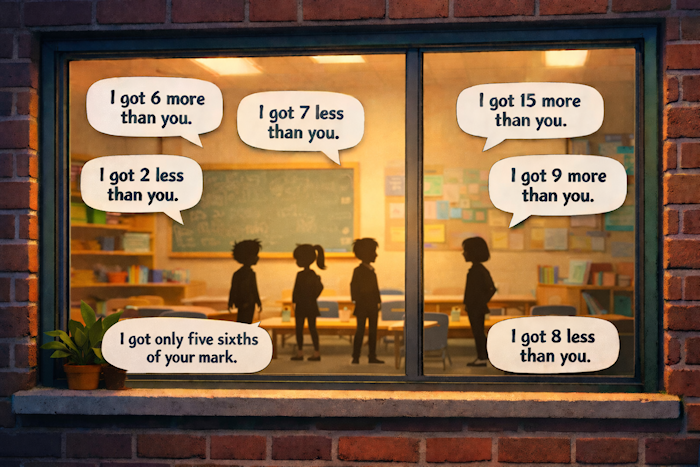
What were the four integer test scores if only one of them was even and everyone earned at least three quarters of the available marks?
If you get an answer, I'd love to hear how you solved the puzzle or how your students solved it. Fire off an email to gro.musnarT@rettelsweN
While you think about that, here are some of the key resources on the Transum website you may never have seen before.
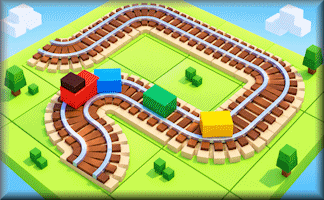
All aboard for Tracks, a logic puzzle starting where Path Puzzle left off! Your challenge is to place pieces of railway track in the correct positions, using the numerical clues to work out where they belong. It's the sort of thing you could set as optional homework, challenging students to complete as many levels as possible.
Properties of 2D Shapes is an exercise that gets students looking closely at shapes rather than just naming them. For each shape, they set sliders to indicate the numbers of sides and angles, then check their answers. Level 1 counts sides and angles on everyday polygons. The later levels move on to identifying and counting acute, right and obtuse angles, quadrilaterals and other polygons, a set of strange shapes, and finally circles and curved shapes, which make students think about what counts as a side at all.

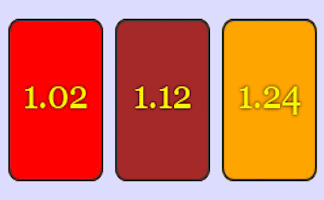
Mentally doubling numbers is a very useful skill that can be practised with Double Drag. Students drag number coins onto the cards showing their doubles. It starts gently with single digits, then works through two- and three-digit numbers and decimals, and ends with a level I've called "So many sixes", where 6, 0.6, 0.06, 6.06, etc. all look suspiciously alike. A correct match merges into its card and shows the addition, while a wrong guess costs five seconds, which seems to be enough to discourage random dragging.
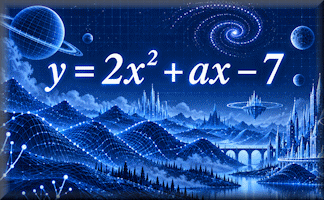
Graph Unknowns is a strange title, but that's not unusual for Transum! Use clues about expressions and their graphs to find the missing values. The questions focus on quadratics, cubics, a quartic, a reciprocal graph, an exponential graph and an absolute-value graph.
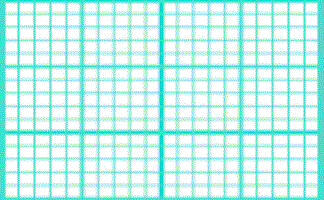
Graph Paper is one of the oldest visual aids on the site, but is still really useful in 2026. Just type the smallest and largest values for each axis and the origin finds its own place. The x-axis can be numbered in degrees or multiples of π, which is handy for trigonometry graphs. You can print up to six grids on a sheet of A4, and every setting is saved in the page address, so you can share a ready-made grid just by sending the link. Have a play and let me know what you think.
Do you need a never-ending supply of linear equations for your lesson? The eQuation Generator can produce a huge number of different equations, across five types: one-step, two-step, unknowns on both sides, brackets and fractions.
Choose Simple, Medium or Hard. Then click Answer to reveal the working one line at a time, so the class can predict each step before you show it.
When they're ready, one click gives your students a link to a self-marking exercise at the same level, with a trophy to earn.

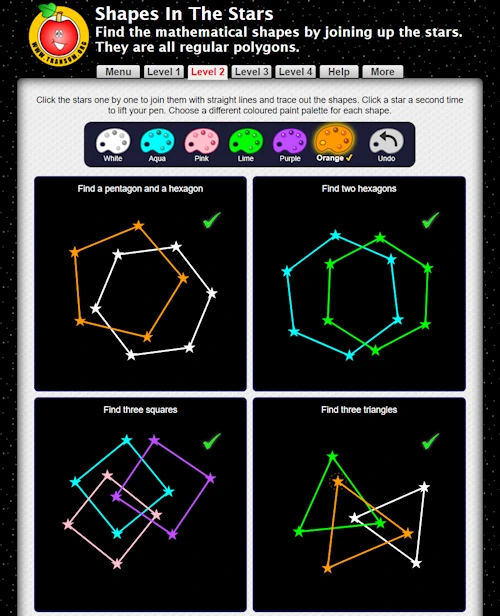
Did you know there are Shapes in the Stars? Many students have earned trophies for completing it over the many years that it's been on the website. If you haven't come across it, it's well worth having a look as it provides quite a different way of developing students’ ability to recognise polygons.
Very few people have claimed a trophy for completing the Paradox activity. Level 4 contains statements at GCSE level, so there's a revision element as well as getting your head around the idea of a paradox.

Fibonacci Day is on the 23rd November though the link with this date is a bit of a stretch (written in the American month/day format, 11/23 gives the digits 1, 1, 2, 3). There are so many examples of Fibonacci numbers cropping up in unusual places and these provide a great way to engage your students in some real-world maths..
Finally, the answer to last month's puzzle, which was:
At Halloween, a shopkeeper bought six boxed surprises. One box contained treats, while the other five contained horrible tricks. Written clearly on the boxes were these prices: £15, £31, £19, £20, £16 and £18.
He kept the box of treats for himself, but sold all five trick boxes to two customers called Morbid and Cruella.
The total price of the boxes bought by Morbid came to exactly twice the total price of the boxes bought by Cruella.
What was the cost of the box containing the treats?
The total price of the five trick boxes must be a multiple of 3 because Morbid and Cruella’s totals are in the ratio 2:1. The prices of all six boxes add up to £119, which leaves a remainder of 2 when divided by 3. The price of the treats box must therefore also leave a remainder of 2 when divided by 3. Only £20 qualifies. This works: Morbid bought the £31, £19 and £16 boxes for £66, while Cruella bought the £15 and £18 boxes for £33.
Thanks so much to all of you newsletter readers out there who sent in solutions and methods. Some of them are below in the comments and I really enjoyed receiving them.
This puzzle was adapted from a puzzle called The Barrel of Beer from Amusements in Mathematics by Henry Ernest Dudeney
That's all for now,
John
P.S. There are 360° in a circle. A square has four right angles, so there are 360° in a square.
I need to be more careful with my language!
Do you have any comments? It is always useful to receive feedback on this newsletter and the resources on this website so that they can be made even more useful for those learning Mathematics anywhere in the world. Click here to enter your comments.
Did you know you can follow this newsletter on Substack completely free of charge? Please note this is separate from a paid subscription to the Transum website, which unlocks a much wider range of premium resources.


Kevin, Australia
Thursday, October 1, 2026
"I have 20 pounds as my answer because it is the only number that subtracts from the total (119) to leave a number (99) which can be divided in the ratio 2:1"
Chris, Scotland
Thursday, October 1, 2026
"Adding the six box totals gives £119.
Morbid's total is twice Cruella's so their combined value is a multiple of 3.
The only box the shopkeeper can keep and leave a multiple of 3 is £20.
Then £99 remains. So Cruella's total is £33 and Morbid's is £66.
Here's how that happens:
Shopkeeper: £20
Cruella: £15 and £18
Morbid: £16, £19, £31
"
Rick, United States
Thursday, October 1, 2026
"Adding the cost of all the boxes results in a total of £119. Since the total price of the boxes bought by Morbid came to exactly twice the total price of the boxes bought by Cruella, the total cost of the five trick boxes must be divisible by three. Only the £20 box that, when subtracted from the total, satisfies this criterion. Hence, the box containing treats is the one marked £20."
Farzad, Canada
Friday, October 2, 2026
"Suppose the total of one is x and the other one is 2x. This combined 3x. Now we add all together we get 119. We went to make sure the remaining five is a multiple of 3. The only candidate is 20. So once you that one out the is 99 and gives x 33. So trick is (15+18) and (16+19+31). This is my draft. Hope it is what you were looking for."
Leonard, United States
Saturday, October 3, 2026
"Here is my crack at October’s monthly puzzle.
The cost of the box containing the treats was £20. The boxes bought by Morbid were £16, £19, and £31 (totaling £66). The boxes bought by Cruella were £15 and £18 (totaling £33).
The key to the problem for me was the last sentence before the question. “The total price of the boxes bought by Morbid came to exactly twice the total price of the boxes bought by Cruella.” With one price exactly twice the other, we know that the sum of the two prices must be a multiple of three.
Starting with the set of prices {£15, £16, £18, £19, £20, £31}, my first thought was to eliminate one price, sum the remaining five and then check to see if it was divisible by three. This would have required four additions and a division by three (six times). Instead, I decided to divide each of the six prices by three and note the remainders, getting the set {0, 1, 0, 1, 2, 1}.
For the sum of five prices to be divisible by three, the sum of their remainders must also be divisible by three. The only such sum uses the 1st, 2nd, 3rd, 4th and 6th prices, leaving out the £20 box. All that remains is to divide the remaining five prices into groups totaling £33 and £66, which can be easily achieved by grouping the 0s and 1s in the previous list. "
Adam Alcorn, America
Thursday, October 8, 2026
"I got 20 as the box as the good one because if you take 15 and 18 which = 33 and 16 + 19 = 35 + 31 box and that's 66 so 20 is the one left. I am from America if you are wondering. Can't wait for the next challenge. (:"
Mala, New Zealand
Sunday, October 11, 2026
"Since Morbid paid twice the amount paid by Cruella, he would have bought 3 of the boxes and the possible combination is- he bought the boxes costing 31,16 and 19 pounds amounting to a total of 66 pounds. Therefore, Cruella would have bought the 2 boxes that cost a total of 33 pounds – 18 and 15 pounds. The cost of the box of treats was, therefore, 20 pounds."