
Sign In | Starter Of The Day | Tablesmaster | Fun Maths | Maths Map | Topics | More
Once again, I would like to share with you the Transum Newsletter. This one is for the month of March, but the puzzle of the month is not about marching. It is about waddling and scuttling!
A penguin starts to waddle from a sand castle to the rocks on a beach at the same time as a crab starts to scuttle from the same rocks heading for the same sand castle. They pass each other at 11am and the penguin reaches the rocks at 1pm while the crab doesn’t arrive at the sand castle until 3:30pm.
What time did the waddling and scuttling begin?
This image shows the penguin and the crab looking in the same direction. Don't let it distract you! It has been included for a splash of colour only.
If you get an answer, I'd love to hear how you solved the puzzle (or your students solved it). Fire off an email to: gro.musnarT@rettelsweN
While you think about that, here are some of the key resources added to the Transum website during the last month.
Speed Skills is a short, self-marking practice activity that helps students build confidence with speed as a rate. It focuses on choosing and using the right formula, keeping units consistent, and converting smoothly between common forms (for example, m/s, km/h and miles per hour). Students need to read the questions carefully, decide what information is actually needed, and type in an answer with sensible units. A variety of commonly used units are accepted. It is also a good way to spot the usual misconceptions and address them without having your time tied up with marking.

Crossing Bridges is an engaging challenge. Students must find a path that crosses every bridge exactly once without repeating any bridge. The activity features five progressively difficult challenges based on the famous Seven Bridges of Königsberg problem that inspired mathematician Leonhard Euler to develop graph theory in 1736. Hopefully, students will develop strategic thinking and problem-solving skills as they learn to analyse networks and plan their routes carefully.
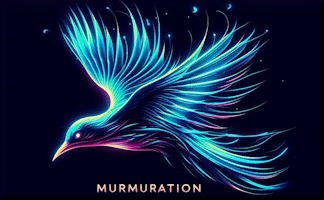
Murmuration is a new challenge requiring students to estimate large numbers of items while they are moving. This five-level activity was created to strengthen students' estimation skills through increasingly complex scenarios (50 to 1,000 birds). Students' answers must be within 10% of the actual number to earn each level's trophy. The beautiful, physics-based animation keeps students engaged while they practice a crucial mathematical skill: making reasonable estimates when exact counting isn't practical, a skill they'll use in everyday life. Warning: it can be mesmerizing watching the murmuration!
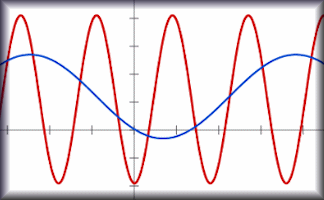
Transformations of Trig Graphs is a new activity that I have already used with students successfully. Users see a red target curve and a blue curve that scroll across the screen. They then edit a single function to make the blue graph match the red one. It’s a quick, engaging way to learn about the effect of the parameters in transformations of trigonometric graphs. The built-in checking gives immediate feedback and a trophy is available for each level, which makes it ideal for a short starter, a homework task, or a bit of focused practice when students need to sharpen their graph interpretation skills.
Largest Product has been updated to prevent clever (and mischievous) students from cheating the self-marking software by including two multiplication signs together, which the software interpreted as "to the power of" giving them enormous products. What hacks will they find next? They're keeping me on my toes (is that still a well-known expression?).
One of my students showed me how he remembers the Common Trig Ratios using a mnemonic diagram. I hadn't seen it before but I was impressed how simple it was to use. I have put the diagram along with instructions for using it in the Help tab of the Common Trig Ratios exercise.
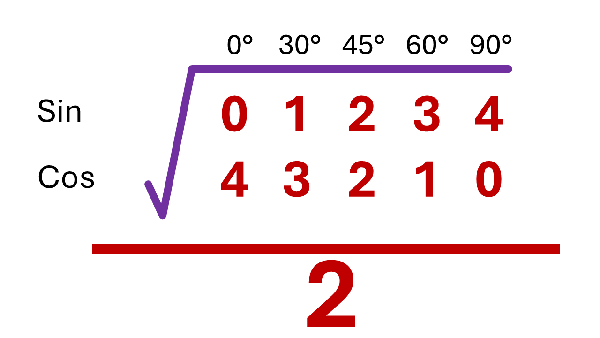
A well‑chosen mnemonic isn't about replacing understanding; it's about reducing cognitive load so students can focus on the real mathematics. Yes, they could redraw right‑angled triangles and re‑derive the ratios every time, but that’s slow, error‑prone, and distracts from whatever problem they’re actually trying to solve. A mnemonic gives them instant access to the standard values, freeing up working memory for reasoning, problem‑solving, and making connections. In the same way we don’t expect students to re‑invent multiplication facts before tackling algebra, having these key trig values at their fingertips lets them work more confidently and efficiently.
Having said that, I always avoid encouraging the use of that triangle mnemonic that is often used to switch between the speed, distance, time formulae. I didn't even mention it in the video I just made for the help tab in the Speed Skills exercise mentioned above.
Here are some special dates in the month ahead that have related maths-themed activities on the Transum website:
5 March :: World Book Day
14 March :: Pi Day
17 March :: Saint Patrick's Day
21 March :: Poetry Day
Finally, the answer to last month's puzzle which was:
Percy and Nelly Cod are brother and sister from a large family.
Percy was 19 pence short of the amount needed to buy a badge. Nelly, meanwhile, was just one penny short of affording the same type of badge. They decided to pool their money to buy one badge to share, but even together, they still didn’t have enough.
Here’s what we know about the Cod siblings:
Percy has three times as many sisters as brothers.
Nelly has twice as many sisters as brothers.
How much would it cost Mr and Mrs Cod (Nelly and Percy's parents) to buy badges for all of their children?
The solution is:
The cost of one badge is 19p
The total number of children is 13
The total cost is 13 x 19 which means the total bill is £2.47
Only one person managed to solve the puzzle this month. Well, perhaps that's not completely accurate, but I only received one response and that was from Rick (you can see it below). Thanks very much Rick, great to hear from you.
That's all for now,
John
P.S. It's the first day of the month. We all have a long March ahead of us. I hope you don't get blisters!
Do you have any comments? It is always useful to receive feedback on this newsletter and the resources on this website so that they can be made even more useful for those learning Mathematics anywhere in the world. Click here to enter your comments.
Did you know you can follow this newsletter on Substack completely free of charge? Please note this is separate from a paid subscription to the Transum website, which unlocks a much wider range of premium resources.


Rick, USA
Wednesday, February 4, 2026
"I assume pence and penny are the same.
Since Nelly is only 1 penny short of buying a badge and with Percy’s total, they still cannot buy a badge, Percy has no money. He is 19 pence short, so a badge must cost 19 pence and Nelly has 18 pence.
Percy has three times as many sisters as brothers. Therefor , he has 1 brother and three sisters, 2 brothers and six sisters, 3 brothers and nine sisters, …
Nelly has twice as many sisters as brothers. If Percy has three brothers, then Nelly has four brothers and eight sisters, meeting the two to one ratio. Thus, Mr. and Mrs. Cod have 13 children and would need to spend 247 pence. Of course, this would be reduced to 229 pence if Nelly contributed her 18 pence. "